Misaligned Implementations
A connected system meets the technical spec but misses the operating workflow. Teams inherit rework and new points of friction.
Technical proficiency is essential. Graduates also need to connect their expertise to the people, systems, and decisions that depend on it.
The educational gap
Students need practice translating technical expertise into shared decisions—especially where digital systems meet physical operations.
Take it into your classroom
Download the full resource pack (HTML) · One-page discussion brief (PDF)
Open any resource to print or save it as a PDF. Teaching materials are drafts you can adapt to your course.
The cost of siloed learning
A connected system meets the technical spec but misses the operating workflow. Teams inherit rework and new points of friction.
A rollout overlooks equipment constraints, training, or time needed for a safe change. Implementation stalls while teams resolve competing priorities.
A security procedure is unclear or does not fit daily operations. People may bypass it to keep work moving.
Illustrative risks—not inevitable outcomes or failures caused by learning alone.
Communication in Context responds to this gap by bringing those conversations into the learning experience—around shared problems with real people, constraints, and consequences.
Download the one-page discussion brief PDF · Framework + sample rubric
A working definition
Communication in Context brings people from different disciplines into conversation around a shared problem, so students can connect technical knowledge with the setting in which it is used.
02 / Where it began
Faculty externships helped shape this idea: understanding a workplace means seeing how people work together, what decisions they face, and why a technical task matters. Kyle Jones’s NCyTE Faculty Externship annual reports document these connections across the 2023, 2024, and 2025 program years.
The 2023 report describes plans for team-based capstones and collaboration with a speech department. The 2024 report highlights collaborative planning, documentation, and oral and written deliverables. In 2025, communication, governance, and structured decision-making emerge as recurring priorities.
Read the examples: 2023, pp. 8–10 · 2024, pp. 9–11 · 2025, pp. 8–10.
The IT/OT connection
The paper Bridging the IT/OT Cybersecurity Skills Gap places the educational gap in a concrete setting: information technology (IT) manages data and networks; operational technology (OT) monitors or controls physical processes, such as production equipment. As these systems connect, the paper argues that workforce preparation must connect their disciplines too.
A network decision can also be an operations decision. Students need to ask what a change means for equipment, continuity, people, and the organization.
The paper identifies clear communication with technical and nontechnical audiences as a core competency. Explaining consequences belongs alongside configuring a system.
Paper: IT/OT convergence, pp. 7–8 · communication and curriculum, pp. 15–17.
Communication in Context carries these insights into a teaching question: how can students practice connecting their expertise with other people’s needs before entering the workplace? The shared problem, different perspectives, and decision brief below are a proposed classroom response.
Explore the paper and annual reports →03 / Guiding principles
Begin with a workplace need: connect equipment, support care, or improve a process. Let that purpose guide the technical work.
Bring IT, operations, business, and other relevant disciplines into the same decision. Ask what each team knows that the others need to understand.
Make equipment limits, workflows, security needs, costs, and human consequences part of the assignment—not background information.
Ask students to explain a recommendation to another role, clarify unfamiliar language, and document what changed after the conversation.
04 / In practice
Use a shared workplace problem inside an existing course. The clinic example below explores how technical choices affect care and workflow; the manufacturing variation applies the IT/OT paper’s emphasis on communication across connected systems.
Prompt: A manufacturer wants production data from an existing machine to appear on a shared dashboard. What must the team understand before recommending how to connect it?
Use the same 30-minute rhythm: assign roles, negotiate a tradeoff, and deliver one shared brief. Include the recommendation, an unresolved question, who must answer it, and one revision prompted by another role.
An illustrative classroom prompt informed by the paper’s competencies and curriculum discussion, pp. 13–17.
The 30-minute rhythm
Groups of five take the Technology, Healthcare, Business, Communication & Design, and Cybersecurity perspectives. Use the clinic prompt and matrix below; capture the decision in one shared document.
One shared problem statement.
One priority and one question per role.
One decision and its cross-disciplinary tradeoff.
A recommendation, benefit, tradeoff, and revision.
One change in thinking after peer feedback.
Use assigned perspectives in a single-program class or disciplinary knowledge in a mixed group. Students label assumptions and questions for real stakeholders.
Classroom simulation prompt
What would make the system useful, understandable, and appropriate for the people who rely on it?
Choose a perspective. Notice how the questions change.
Students compare these perspectives, identify tradeoffs, and explain a proposed approach together.
A proposed classroom activity for faculty to adapt; not a report of a tested seminar.
Read each row across, then select a decision to explore its tradeoff. These are illustrative possibilities to discuss, not measured outcomes.
On smaller screens, scroll the table sideways to compare all five disciplines.
| Decision to explore | Technology | Healthcare | Business | Design | Cybersecurity |
|---|---|---|---|---|---|
| Plan synchronization and recovery. | Keep arrivals moving during outages. | Budget for maintenance and support. | Explain when information is saved. | Protect locally stored information. | |
| Provide an appropriate staff interface. | Fit assistance into the care workflow. | Plan staffing and training time. | Make the help option easy to find. | Define staff access and audit needs. | |
| Limit scope and gather reliability data. | Choose a representative care setting. | Set a budget and review criteria. | Gather feedback from varied patients. | Review safeguards before wider rollout. | |
| Change forms and validation rules. | Confirm essential care information remains. | Review rework and support demands. | Use clear language and fewer steps. | Reconsider which data must be collected. | |
| Implement and maintain permissions. | Check access fits care responsibilities. | Plan onboarding and role-change processes. | Explain unavailable actions and help paths. | Limit access and review permissions. |
Selected decision · Healthcare
Assistance can improve access, but the team must coordinate workflow, staffing, and information access.
Discuss: Who provides help, and what should that person be able to see?
05 / From idea to learning
A first experiment could pair an IT course with manufacturing, engineering, business, or healthcare around one challenge. Keep the technical learning goals, and add a shared explanation of the decision and its consequences.
The IT/OT paper also argues for industry partnerships and faculty externships to keep curriculum connected to workplace needs. Invite an employer or advisory-board member to help frame the problem, identify realistic constraints, and review the students’ recommendations (pp. 18–20).
Walk through a possible learning experience.
06 / Publications & reports
A paper on the IT/OT skills gap and three faculty externship annual reports by Kyle Jones connect workforce needs with teaching. Explore the original documents and the classroom conversations they suggest.
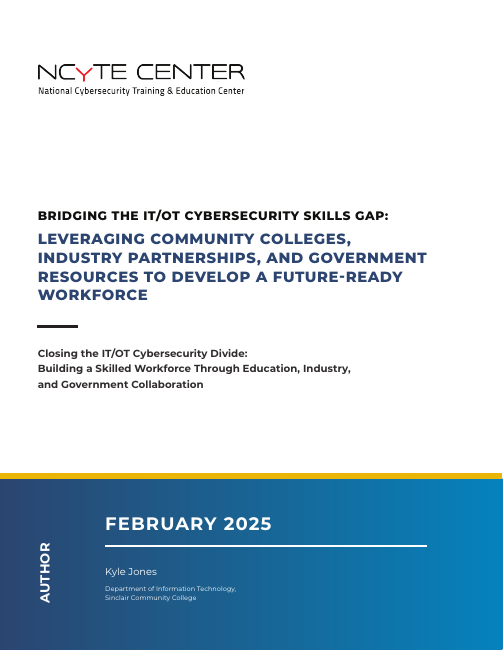
Leveraging Community Colleges, Industry Partnerships, and Government Resources to Develop a Future-Ready Workforce
Connected systems need connected expertise.
This paper examines workforce preparation where information technology and operational technology meet. It argues for integrated curricula, hands-on experience, and partnerships that develop technical capability alongside communication and collaboration.
Use a shared scenario: a manufacturer wants to connect an existing production machine to its network. Assign IT, operations, cybersecurity, and business perspectives. Ask each group to explain its priorities, then draft one recommendation addressing security, continuity, and cost.
Compare what the team first proposed with what changed after hearing the other roles. This is a suggested application of Communication in Context, informed by the paper’s discussion of communication and curriculum (pp. 15–17) and faculty externships (p. 20).
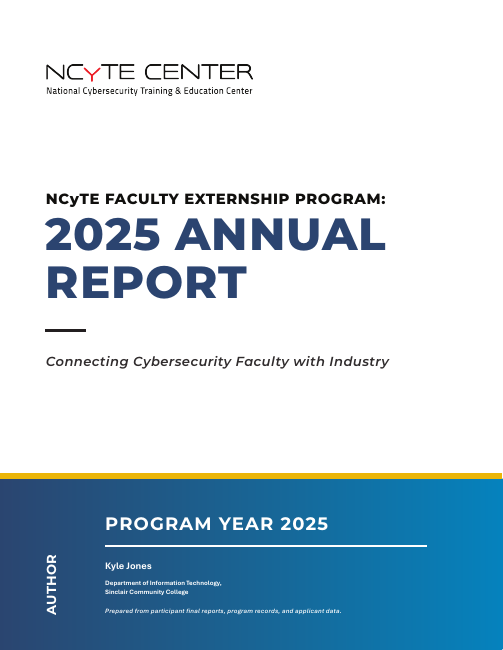
Reasoning, communication, and governance.
Across ten faculty placements, the report identifies documentation, cross-team communication, governance, and structured decision-making as recurring priorities. Faculty describe plans for scenario labs, policy work, and assessment of professional deliverables.
Ask students to explain a recommendation, document its tradeoffs, and revise it after peer critique. This extends the report’s emphasis on actionable reporting and professional judgment.
Suggested teaching application, informed by report pp. 8–10.
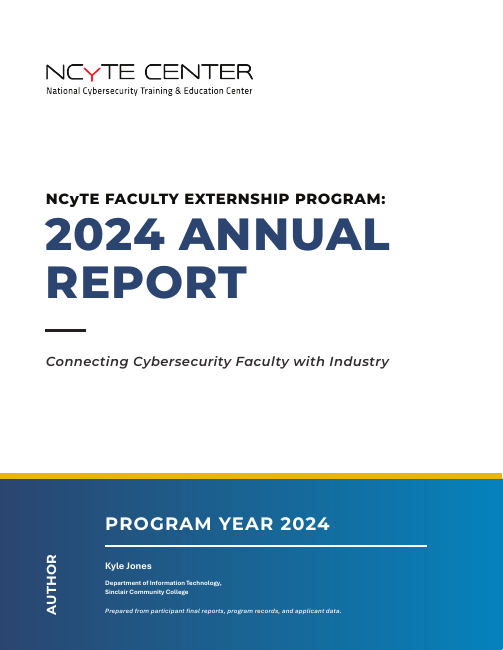
Collaboration belongs inside the technical work.
Eleven faculty externships reveal the importance of teamwork, business context, documentation, and compliance across varied workplaces. Proposed course changes include collaborative planning, after-action reviews, and projects with oral and written reports.
Use distinct team roles and a shared deliverable within an existing assignment. A short after-action discussion can reveal how another perspective changed the team’s plan.
Suggested teaching application, informed by report pp. 9–11.
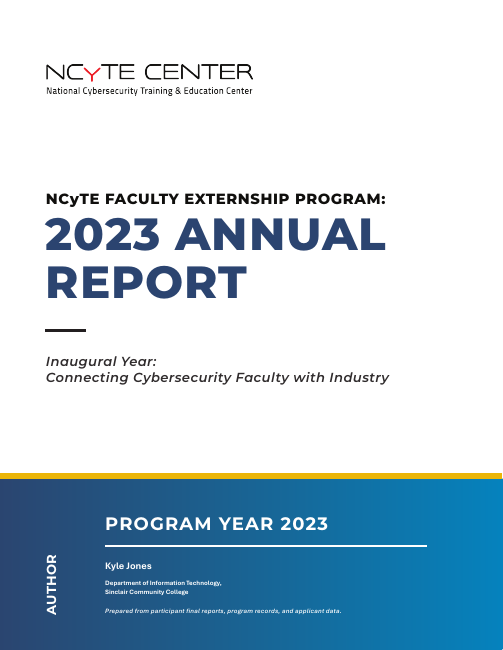
The starting point: bring industry into learning.
The inaugural cohort’s twelve faculty externships connect current industry practice with curriculum plans and continuing partnerships. Examples include peer-tested documentation, real-world team capstones, and collaboration with a speech department.
Have students exchange instructions and test whether a peer can use them. Pair a technical project with a presentation for an audience outside the student’s field.
Suggested teaching application, informed by report pp. 8–10.
The IT/OT paper presents workforce and curriculum recommendations; the annual reports synthesize participant accounts and program records, including planned changes. Together they inform the framework’s development. The classroom activities here are proposed applications, not evaluated interventions in these publications.
Turn the insights into a classroom conversation →07 / Questions to develop
These questions can guide the next version of the framework.
People, purpose, workplace practices, disciplinary language, constraints, and consequences are starting points. For an IT/OT problem, include the physical process, equipment limitations, continuity needs, and the roles responsible for a change. What would a purely technical specification leave out?
Possible outcomes include explaining a technical idea to another discipline, asking better questions, recognizing tradeoffs, and adapting a solution to its setting.
Look for evidence that students can explain how another perspective changed their thinking. Develop criteria that value both disciplinary knowledge and the connections between disciplines.
Explore how faculty can turn workplace observations into shared problems, teaching examples, and conversations with colleagues in other disciplines.
Choose a manageable problem, a small group of collaborators, and one clear learning goal. Use the results to refine the concept before expanding it.